Choosing an IoT SIM provider for energy and utilities is a long-term decision. Smart meters, EV charging stations and energy infrastructure can remain operational for 10 years or more, while mobile networks, security requirements and connectivity technologies continue to change.
In the UK, 3G networks have closed and the remaining 2G networks are scheduled for retirement. This makes it important to evaluate more than coverage and data pricing.
This guide explains six criteria for comparing IoT SIM providers, from network resilience and security to remote management and total cost of ownership.
Six criteria for evaluating an IoT SIM provider
Compare any IoT SIM provider on six criteria: coverage where your assets are, resilience if a network fails, adaptability over the asset lifecycle, security, central management and total cost. Use these criteria to compare providers consistently and identify the best fit for your deployment.
- Coverage: Which networks work at your actual deployment locations?
- Resilience: What happens if your preferred mobile network becomes unavailable?
- Adaptability: Can your IoT SIM connectivity adapt as requirements change?
- IoT security: How is connectivity secured between your devices and infrastructure?
- Connectivity management: Can you centrally manage hundreds or thousands of IoT SIMs?
- Total cost of ownership: What will IoT connectivity cost over the entire asset lifecycle?
What is an IoT SIM provider?
An IoT SIM provider supplies SIM or eSIM technology and mobile connectivity that enable IoT devices to send and receive data. Specialist IoT connectivity providers often offer multi-network access, centralised connectivity management, APIs and security features.
In the energy and utilities sectors, the SIM may be installed directly in a smart meter, EV charging point or another connected device. Alternatively, mobile connectivity may run through a router, gateway, remote terminal unit (RTU), controller or data logger that connects one or more assets.
Mobile connectivity can be the primary connection, or a backup if, for example, a fixed-line connection fails.
IoT SIM provider vs mobile network operator: what’s the difference?
An MNO, such as EE, Virgin Media O2 or VodafoneThree, operates its own mobile network. A specialist IoT connectivity provider typically combines connectivity from several operators with technology for network selection, connectivity management, security and international deployments.
An MNO may be sufficient when your assets operate primarily in the UK and a single network meets your requirements. A specialist IoT connectivity provider may be more suitable when you need access to multiple networks, international coverage, centralised management or the ability to change your setup during the deployment.
What connectivity requirements matter for your energy or utility application?
Not every energy or utility application has the same connectivity requirements. Location, lifespan, scale and the consequences of a lost connection determine which requirements matter most.
| Application | Purpose of the connection | What to look for |
|---|---|---|
| Smart meters for electricity, gas, water and heat | Remote meter reading, monitoring and management. | Indoor coverage, LTE-M/NB-IoT, battery consumption, management at scale and migration path. |
| EV charging stations | Payment authorisation, charger monitoring, remote diagnostics and fault notifications. | Reliable connectivity, network failover, security, remote diagnostics and recovery procedures. |
| Solar farms and inverters | Monitoring energy production, performance and faults. | Coverage in remote locations, router or gateway connectivity, remote diagnostics and potentially cellular backup. |
| Wind farms | Monitoring operational data and faults. | Coverage in remote locations, reliable connectivity, redundancy and secure remote access. |
| Battery energy storage systems (BESS) | Monitoring status, performance and faults, and managing systems remotely. | Reliable connectivity, security, network segmentation, secure remote access and redundancy. |
| Substations and grid automation | Monitoring grid status and managing equipment remotely. | Availability, network segmentation, security, monitoring and redundancy. |
| Water and wastewater infrastructure | Monitoring pumps, levels, water quality and remote installations. | Coverage, low power consumption, reliability and long service life. |
| International deployments | Centrally managing assets across multiple countries. | Available operators by country, mobile technologies, roaming conditions, local restrictions and centralised management. |
An asset that periodically sends small amounts of data has different connectivity requirements from an installation that is continuously monitored remotely.
Which IoT SIM providers are there in the UK?
The UK has three mobile network operators: EE, Virgin Media O2 and VodafoneThree. IoT SIMs come from those operators, from specialist providers and resellers, and from international providers such as Wireless Logic, Eseye, 1NCE, Onomondo, emnify and Soracom. There is no official ranking. The right choice depends on where your assets are, the hardware they use and how many connections you run.
One important difference between IoT SIM providers is how they provide access to mobile networks. A single-network SIM generally relies on one operator's network, while a multi-network SIM may access several networks, depending on the SIM configuration, device compatibility and network agreements.
However, multi-network access does not automatically guarantee uninterrupted connectivity. Ask providers which networks are available at your locations, how network selection and failover work in practice, and whether roaming restrictions apply.
Which IoT connectivity providers should you compare for energy and utilities?
The market includes mobile network operators, specialist IoT connectivity providers and cloud-native platforms. The table below lists providers to consider for UK and international IoT deployments and highlights capabilities to evaluate when comparing them.
| Provider | Type | Key areas to evaluate |
|---|---|---|
| Wireless Logic | Specialist IoT connectivity provider |
Multi-network and international IoT connectivity, SIMPro connectivity management, Conexa mobile core, SGP.32 eSIM with managed remote SIM provisioning, and support for large-scale deployments. |
| Eseye | Specialist IoT connectivity provider | Global multi-operator connectivity, network localisation, IoT SIM and eSIM solutions and centralised connectivity orchestration for international deployments. |
| 1NCE | IoT connectivity provider | Standardised connectivity model with predictable upfront costs and long-term IoT connectivity. |
| Onomondo | IoT connectivity provider | Proprietary mobile core, multi-network connectivity and network and device insights. |
| emnify | Cloud-native IoT connectivity provider | APIs, automation, real-time insights and centralised connectivity management. |
| Soracom | Cloud-native IoT connectivity provider | Global mobile connectivity, API-driven management, cloud integrations and SGP.32-based profile management. |
| Telenor IoT | Mobile network operator | Global managed connectivity, international partner networks, global roaming and SGP.32. |
How to evaluate an IoT SIM provider: six criteria explained
1. Is there coverage where your assets are actually located?
The number of countries or mobile networks a provider claims to cover means little if a meter in a basement or an installation in a rural area cannot establish a reliable connection.
Check which mobile networks and technologies are available at the locations where your assets operate. Consider 4G, 5G, LTE-M and NB-IoT. The modem, supported frequency bands, antenna, device placement and surrounding environment also affect connectivity.
Wireless Logic provides access to more than 750 mobile networks in 165 countries.
Learn more about Wireless Logic’s network coverage.
2. What happens if a preferred network isn’t available?
A single-network SIM cannot switch to another mobile network if its assigned network becomes unavailable locally.
With multi-network connectivity, a device can switch to another network, depending on the SIM, hardware, configuration and roaming agreements. Check which networks are available, how network selection works and what happens when the active network becomes unavailable.
For locations where connectivity is important to business operations, cellular connectivity can also provide backup alongside a fixed-line connection.
At an EV charging point, lost connectivity can disrupt payment authorisation, remote monitoring and fault notifications, depending on the charger's configuration. Read the Osprey success story.
Learn more about multi-network IoT SIMs.
3. Can your IoT SIM connectivity adapt throughout your assets’ lifecycle?
An energy or utility asset can outlast the mobile technology it launched on. Your requirements can change too, if you expand into new markets, add operators or update security and management policies.
Different technologies offer different levels of flexibility. Multi-network connectivity and multi-IMSI can provide access to alternative networks, while eSIM/eUICC and remote SIM provisioning can enable remote changes to operator profiles. SGP.32 is a GSMA specification designed to support remote SIM provisioning for IoT devices.
Wireless Logic supports SGP.32 through its managed eSIM offering, including remote SIM provisioning and lifecycle management of eSIM profiles.
Ask each provider which network and SIM profile changes you can make remotely during an asset’s lifecycle and which need physical access.
An eSIM does not change the radio technology supported by the hardware. A 2G-only modem cannot connect to 4G, LTE-M or 5G simply because it uses an eSIM.
In Spain, a regulation in force since October 2023 requires remote meter readings at border and cogeneration points to use IP communication instead of CSD, a GSM-based technology that is being phased out. Smart metering manufacturer Enerclic has built a 4G device, the IP Meter, using Wireless Logic connectivity. It lets metering managers replace obsolete GSM modems. According to the case study, more than 100,000 smart meters in Spain need to migrate to IP-based communications. Read the Enerclic case study.
When will the UK switch off 2G and 3G?
UK operators have closed 3G. These are their announced 2G closure dates:
| UK operator | 2G shutdown plans | 3G status |
|---|---|---|
| EE | From May 2029 | Closed |
| VodafoneThree (Three network) | No 2G network | Closed |
| Virgin Media O2 | From summer 2029 | Closed |
| VodafoneThree (Vodafone network) | Spring 2030 | Closed |
Sources: EE, Virgin Media O2, VodafoneThree and Ofcom. Last reviewed: October 2026.
The impact can occur before a network’s final shutdown date. For example, Virgin Media O2 began withdrawing inbound 2G roaming in October 2025, affecting certain international IoT SIMs.
For energy and utility deployments, this means checking which networks devices actually use, whether their hardware supports newer technologies and whether alternative networks are available.
Ask your provider how network sunsets and roaming changes are monitored, how affected devices are identified and which migration options are available.
For the latest operator information, see Wireless Logic’s global network closures overview.
4. How is connectivity secured?
Many energy and utility assets operate outside the traditional IT perimeter, from smart meters and EV chargers to substations and remote installations. This makes visibility and control over the connectivity layer an important part of IoT security.
Ask whether a provider offers private networking, network segmentation, encrypted connections, access controls and monitoring. Also consider whether unusual connectivity behaviour can be detected, such as unexpected data usage or communication patterns.
Wireless Logic combines private networking with its own mobile core network, Conexa, and offers AI-powered Anomaly and Threat Detection as an additional security layer, depending on the connectivity solution. This helps organisations gain greater visibility into connectivity-related threats across their IoT deployments.
Connectivity security complements, rather than replaces, device and application security. UK energy and utility organisations may also be subject to the Network and Information Systems (NIS) Regulations, depending on their activities and regulatory status.
Learn more about IoT security.
5. Can you centrally manage hundreds or thousands of connections?
Managing SIMs manually becomes impractical as deployments grow. A connectivity management platform provides visibility into connection status and data usage, and can support activation, alerts, diagnostics, bulk changes and automation through APIs.
Wireless Logic’s SIMPro platform helps organisations centrally manage and monitor IoT connections. Conexa, Wireless Logic’s own mobile core network, provides greater control over connectivity services across participating networks. Available capabilities depend on the connectivity solution and deployment.
Also consider support hours, response times, escalation procedures and the provider’s role in resolving issues involving underlying MNOs.
Learn more about IoT connectivity management.
6. What does connectivity cost over the entire lifecycle?
The price of a SIM or data plan is only one part of the total cost.
A total cost of ownership (TCO) calculation should also include installation, management, support, data usage, integrations, on-site interventions, hardware replacement and future migrations.
Consider a deployment of 5,000 meters that require physical visits because a SIM, modem or configuration cannot be updated remotely. The cost of those visits may outweigh a small difference in monthly connectivity charges.
Compare providers on cost over the expected lifetime of the deployment.
Learn more about total cost of ownership for IoT.
Want to see where Wireless Logic’s networks are available? Explore the coverage map.
What do independent analysts and users say about Wireless Logic?
Independent analyst research and user reviews give an outside view when comparing IoT connectivity providers. Gartner and Transforma Insights evaluate providers from different perspectives, while Gartner Peer Insights collects feedback from business users.
Gartner positioned Wireless Logic as a Leader in both the 2025 and 2026 editions of the Magic Quadrant for Managed IoT Connectivity Services, Worldwide. The research evaluates providers based on their Ability to Execute and Completeness of Vision. The 2026 edition also covers 1NCE, emnify, Soracom and Telenor.
On Gartner Peer Insights, Wireless Logic has an average user rating of 4.7 out of 5 from 50 ratings, as of October 2026.
Transforma Insights assessed Wireless Logic in its Communications Service Provider IoT Peer Benchmarking Report 2025, alongside 26 other international IoT connectivity providers, including 1NCE, Onomondo, emnify, Soracom and Telenor. The research covers areas such as network architecture, international connectivity, connectivity management and experience in specific industry sectors.
Use these studies to build a shortlist, then test the findings against your deployment locations, hardware, availability requirements, security needs and expected lifespan.
What questions should you ask an IoT SIM provider?
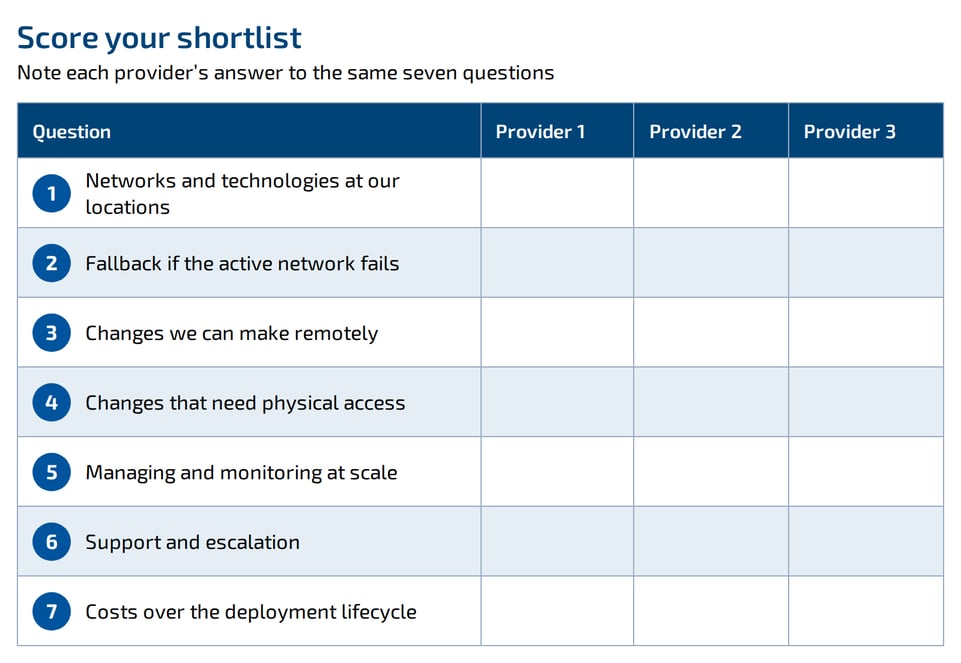
Ask every provider the same questions:
- Which mobile networks and technologies are available at our deployment locations?
- What happens when the active network becomes unavailable?
- Which network or SIM profile changes can we perform remotely?
- Which changes require physical access to the SIM, modem or device?
- How can we manage and monitor large numbers of connections?
- How are support and escalation handled when network issues occur?
- What costs will arise throughout the entire deployment lifecycle?
Find the right IoT connectivity for your deployment
Choosing an IoT SIM provider is a long-term decision, especially when your energy and utility assets need to remain connected for 10 years or more.
Wireless Logic can help you assess network coverage, resilience, SIM and eSIM options, security and connectivity management for your deployment.
Talk to our team about your IoT connectivity requirements.
Check out other blogs

SGP.32 eSIM: How to succeed with next generation IoT connectivity
SGP.32 eSIM is ready - are you? eSIM promises a world of opportunity: global IoT connectivity, lower operational costs and simpler device management....
5 IoT project mistakes to spot before deployment
Connectivity determines whether an enterprise IoT project can scale and how much it costs to keep it running. A flaw in its design or validation...

SGP.32: your technical questions answered
SGP.32 is GSMA’s new eSIM standard for remote SIM provisioning (RSP) in IoT. Designed specifically for the IoT, it enables lightweight, scalable and...