
IoT total cost of ownership (TCO) is a measure of how much an IoT project costs over its lifetime. It incorporates upfront and operational costs, but many companies underestimate it. They forget some cost elements, don’t estimate enough or fail to appreciate the risk of unexpected costs from outages or security breaches. For realistic and manageable IoT TCO, you need a framework that shows you how to assess and reduce Total Cost of Ownership in IoT and to mitigate the risks of unexpected costs, you need resilience to maximise uptime for IoT.
Top 3 takeaways on resilient, cost-effective IoT
- IoT TCO is a complete measure of how much an IoT deployment costs over its lifetime, but it is often underestimated, causing projects to fail
- A 12-point framework can help you forecast the cost of your IoT project. It covers 12 major cost components including hardware, software and platforms, connectivity, data management and security
- To minimise TCO, you must build resilience into your IoT solution. Security measures, rigorous testing and predictive maintenance help maximise IoT uptime and mitigate the risk of unexpected costs arising from breaches, outages and device recalls.
Total cost of ownership makes or breaks IoT projects
The IoT creates a world of possibilities. It enables businesses and sectors to be data-led - to tap into valuable data sets so they can improve efficiency, boost productivity and increase customer satisfaction.
Yet, many IoT projects don’t make it beyond proof-of-concept, go over budget or take longer to implement than expected. Indeed, time to market for IoT-connected products jumped by 80% 2020-2023 to over three years on average, according to IoT Analytics.
Common hurdles can include budget, costs and the time it takes to see a return on investment. IoT Analytics looked at the top concerns or roadblocks of customers of IoT hardware/software and found lack of budget was number three.
Clearly, costs must be prevented from spiralling if IoT projects are to live up to expectations, but how do you do that? To begin with, you must understand IoT TCO.

What is IoT TCO?
IoT TCO is how much an IoT deployment will cost over its lifetime. It incorporates the upfront expense of hardware, software and more, the ongoing cost of running devices and the solution and collecting data, and the outlay for maintenance, training and so on.
Your IoT project could fail if you don’t include all design, implementation and operational costs, or if you underestimate any aspects. Unfortunately, many do just that. They lack a systematic way to evaluate and control known costs and have insufficient understanding of unknown costs – such as those stemming from outages, security breaches or compliance – and end up snatching defeat from the jaws of victory.
TCO components of IoT projects
The fact is, a lot goes into an IoT deployment, and it must all be considered. No fewer than 12 major cost components are at play, contributing complexity and expense. They are:
- Hardware
- Software and platforms
- Deployment overheads
- Connectivity
- Network infrastructure
- Data management
- Security
- Training and change management
- Energy
- Compliance
- Customer experience
- Scalability and innovation.
Wireless Logic has created a 12-point TCO framework to help you forecast the cost of your IoT project.
Get it for free in the white paper: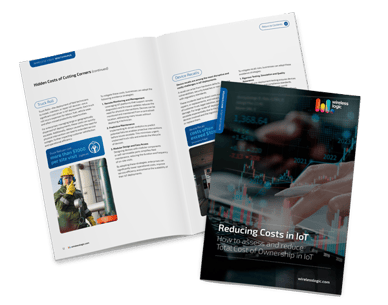
How to assess and reduce Total Cost of Ownership in IoT
How to minimise TCO for IoT projects
Costs can spiral if you don’t have a structured approach to calculate TCO, particularly if you overlook critical factors.
You might be tempted to cut corners or focus only on initial purchase costs, to meet your budget. But this could be a false economy at best. At worst, it could lead to potentially catastrophic costs further down the line.
That’s because the IoT you design and develop is unlikely to be fully resilient and IoT that isn’t resilient, isn’t cost-effective.
How a lack of resilience ramps up IoT TCO
If you overlook resilience, you could end up facing high, and unexpected, IoT costs. These can come from three areas:
Security
Cybersecurity risks are increasing and IoT devices are under particular threat. They were the most frequently attacked in 2024, according to Beaming’s cyberthreat report into UK businesses. This means there is a high risk you and your customers will suffer downtime because of a security
You must mitigate that risk because the consequences of a cyberbreach can be devastating. Firstly, and of obvious importance to TCO, there is the financial impact. Not just the cost of reparations but also the cost of downtime and, potentially, fines if an investigation finds regulatory non-compliance. Then there is the reputational impact, which is often impossible to calculate but undoubtedly the hardest to overcome.
In 2024, Forrester found that over a third (34%) of enterprises that experienced a breach targeting IoT devices were more likely to report costs between $5-and-$10 million. For many companies, that level of impact would be impossible to contain.

A device recall could result from insufficient attention to resilience, and it is among the most disruptive and costly challenges in IoT deployments. At a general level, the average cost of a product recall in the UK is £2.5-5 million but can exceed an astonishing £10 million, according to Insurance Edge.
Hardware defects, software vulnerabilities, a security breach and a failure to comply with regulatory standards can all result in a device recall. However, there are resilience measures you can take to mitigate the risk of these happening and keep TCO manageable.
Outages in the IoT disrupt operations, erode customer trust and cause direct financial losses. Costs come from downtime, a loss of productivity, potential service level agreement (SLA) penalties and repairs and recovery. Again, there is the additional cost of reputational damage and customer churn that can result.
Unplanned industrial downtime costs at least $10K an hour, according to 83% of decision makers, ABB reports, while 76% estimate it is up to $500K an hour. No business case can measure up to that level of TCO impact.
IoT resilience is key to avoid unexpected costs
When your IoT is resilient, you are more likely to avoid the kind of costs that result from a security incident, device recall or an outage.
You must build security into IoT solutions from the start, implement firmware-over-the-air updates to keep devices protected against emerging threats, and monitor to detect any anomalies early so you can act swiftly and minimise impact.
To mitigate recall risks, you must test rigorously, deploy software fixes and security patches diligently and interrogate analytics to identify emerging issues.
You must maximise uptime to counteract the threat of outages. Redundant systems and failover mechanisms provide continuity; predictive maintenance reduces the risk of unplanned downtime and automated incident response accelerates recovery after an issue.
You can find detailed information on these measures, and additional strategies, in the white paper Maximise uptime for IoT
How Wireless Logic can help
Designed and operated well, IoT deployments help companies achieve their goals but implementing and managing IoT-connected devices at scale isn’t particularly simple. Wireless Logic can help you build resilience into your IoT solution and calculate and contain overall TCO, to help your project on the way to success.
Get more information from our white papers:
Check out other blogs

How to choose the right IoT SIM provider for energy and utilities
Choosing an IoT SIM provider for energy and utilities is a long-term decision. Smart meters, EV charging stations and energy infrastructure can...
How does eSIM enable resilient and cost effective IoT?
If you haven’t considered eSIM for your IoT solution, or dismissed it in the past, look again. The latest standard (SGP.32) makes eSIM better suited...

How to implement eSIM
eSIMs are by no means new but have never fully taken off for the IoT, outside of the automotive sector. However, that is set to change with the new...