
It’s easy to underestimate the true cost of IoT. Beyond devices and rollout, hidden expenses can soon appear, ranging from infrastructure and data to maintenance, security and compliance. ‘Cheap’ may be appealing, but can be costly in the long run, which is why you must understand upfront what contributes to the total cost of ownership (TCO) of IoT and how to manage it.
3 reasons your IoT costs more than it should
-
You're only counting what you can see. Upfront hardware and rollout costs are just the start
- Your SIM choice is quietly working against you. Single-networks and region-by-region provisioning create operational complexity that compounds over time.
- Security is a future problem - it's a current cost. Every month you defer it, you're accumulating risk that#s far more expensive to fix than prevent.
12 IoT cost components every solutions designer should plan for
Solutions designers and product managers must look beyond IoT’s initial expenses to understand full and complete costs. One survey discovered over a third of IoT projects fail during proof-of-concept or trial stage and the most often-cited reason for this is the high cost of scaling, mentioned by 32% of respondents.
TCO measures cost over a solution’s lifetime and that is the real measure: upfront expenses, such as hardware and software, as well as ongoing costs of running solutions and collecting data, maintenance, training and more.
All these costs can come as a surprise. Many companies fail to include them all or underestimate some. To avoid this, calculate all known costs systematically and then factor in anticipated unknown costs, such as those that can arise from security breaches.
To help you, Wireless Logic has identified 12 known IoT cost components:
- Hardware
- Software and platforms
- Deployment overheads
- Connectivity
- Network infrastructure
- Data management
- Security
- Training and change management
- Energy
- Compliance
- Customer experience
- Scalability and innovation.
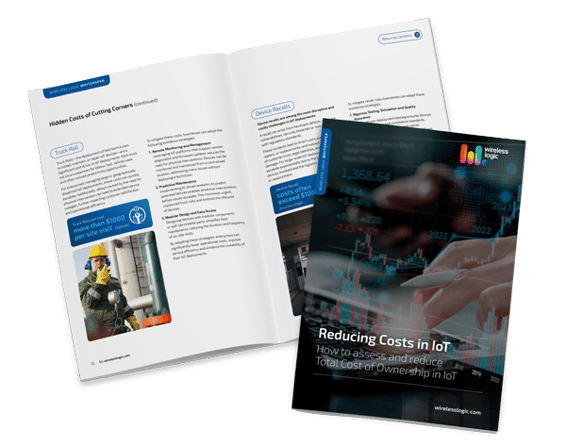
And created a TCO framework to forecast IoT costs. Find it in the white paper: How to assess and reduce TCO in IoT.
How a single-network SIM inflates your IoT total cost of ownership
Early choices shape an IoT project’s TCO and return on investment. A single-network SIM may appear cheaper but could land you with permanent roaming issues. A SIM registered to a local network for each region seems logical but generates multiple stock keeping unit (SKU) codes, which is complicated and incredibly expensive operationally.
If you choose cheaper components, a single-network SIM and put off security decisions you could end up with downtime, reputational damage, regulatory fines and costly recoveries.
Alternatively, if you invest from the outset in building resilience into your IoT design, choose flexible connectivity and plan for lifecycle management, you can reap the benefits of predictability and lasting value.
Why resilient IoT connectivity design prevents your most expensive mistakes
Smarter IoT choices, in design, deployment and investment, help avoid hidden costs and unlock long-term value.
Price-led decisions may not give you long-term flexibility or the ability to adapt should rules or network conditions change. If you think ahead, rather than simply react, your IoT is more likely to be resilient and therefore cost-effective.
This is because a lack of resilience can lead to high and unexpected costs. Take security for example. IoT devices are at high risk from cyberattacks. In fact, they were the most frequently attacked in 2024, according to Beaming’s cyberthreat report into UK businesses. If there is a security breach you, and your customers, could suffer downtime which can have a serious impact on costs.
You may lose revenue whilst your solution is offline, you will have the cost of making good and if the breach is adjudged to have resulted from a lack of compliance with regulation, you could face fines too. Lastly, but with potentially the most long-term impact, your company could suffer a loss of customer confidence and reputational damage.
Build security into your IoT solution from the start, make firmware-over-the-air updates to keep your devices protected and monitor to detect anomalies early so you can act swiftly and minimise impact.
Security is a significant factor in IoT TCO because of the cost implication of getting it wrong. However, it isn’t the only thing that can cause downtime if a solution isn’t resilient. Help minimise downtime risk by testing your solution rigorously, deploying software fixes and security patches rapidly and using analytics to identify emerging issues.
You could consider redundant systems and failover mechanisms for business continuity and predictive maintenance to reduce the risk of unplanned downtime. Automated incident response is an option to accelerate recovery after an issue.
You can find detailed information on resilience measures for the IoT in our white paper Maximise uptime for IoT.

How Wireless Logic can help you reduce IoT TCO across global deployments
To reap the full benefits of the IoT, companies must understand TCO and budget accordingly. Projects that fail to get off the ground because of scaling or cost issues are missed opportunities. Make sure you understand all cost components to factor into your planning from the very start and make informed decisions to build resilience that will help you mitigate costly risks down the line. Wireless Logic can help with this:
Find out more in our white papers How to assess and reduce TCO in IoT and Maximise uptime for IoT and chat to our experts.