
In November, energy stakeholders gathered at Enlit Europe to discuss energy’s transition to a dependable, decarbonised and digitalised energy system. Wireless Logic was there and Mark Appleby, Head of Business Development, presented our vision for tomorrow’s energy with a secure and resilient IoT.
In brief: IoT for Smart Energy at Enlit Europe
- Enlit Europe provided an opportunity to discuss the energy sector’s challenges which include compliance, cybersecurity, interoperability and business intelligence
- Three trends that stood out at the event were digital twins for no/low-code IoT development and management, interoperability across systems and within solutions, and cybersecurity
- The IoT is helping deliver the Smart Grid and energy ecosystem but is only an asset when it is secure and resilient. Energy companies and suppliers to the sector must be proactive through strategies to minimise downtime, cybersecurity, and tactics to recover rapidly and effectively from incidents.
What are the energy sector’s challenges?
As the energy sector continues its digital transition to a Smart energy ecosystem, it faces six significant challenges:
- Utilisation and compliance – energy assets must be online—they support critical infrastructure. Regulation demands this and operators must comply by delivering a secure and resilient energy ecosystem
- Customer experience – digitalisation introduces new equipment. This must be simple and integrate seamlessly. If it doesn’t, demotivated staff will push back, and customers will go elsewhere
- Cybersecurity - critical infrastructure organisations are targets. They suffered 70% of the attacks IBM X-Force responded to in 2024; one in ten of all attacks targeted energy. Smart Energy must be secure to defend against, detect and react to incidents
- Interoperability – equipment must inter-operate with the grid and other services on it
- Business intelligence – Smart Energy calls for data-driven operations with asset tracking, data management, real-time insights, visibility and monitoring, and the means to adapt rapidly
- Sustainability – the ecosystem must scale sustainably, integrate solar and storage with other grid services and use analytics to measure and optimise performance.
What role does IoT Smart Energy play in energy’s transition?
The IoT and connectivity are part of a Smart Energy model that is intelligent, efficient and renewable.
The sector is working to reduce dependence on fossil fuels, establish sustainable energy and implement appropriate storage, management and distribution. So significant is the IoT to this that 1 billion connections are forecast for the sector by 2028.
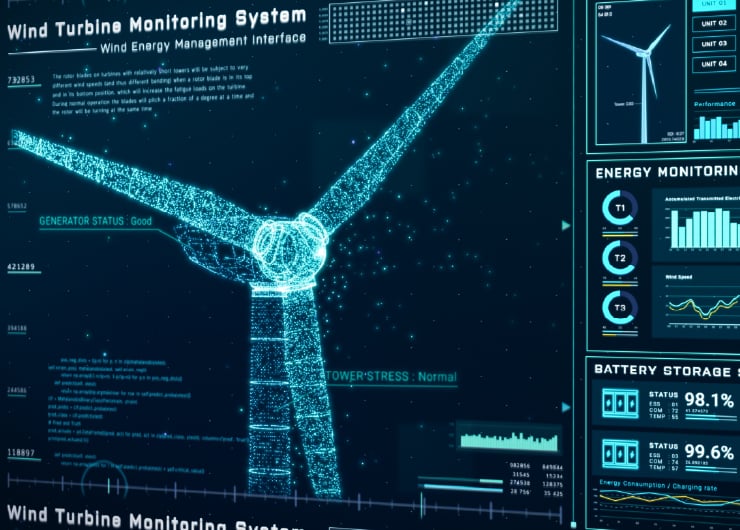
IoT solutions go into solar farms, electric vehicle charging, hydro power plants, carbon tracking, smart meters, microgrids and wind turbines, as well as mechanisms for monitoring energy consumption and selling energy back into the network.
Through the IoT, energy companies access data to monitor devices and conditions, manage installations in remote locations, act on alerts and monitor performance for predictive maintenance.
Enlit Europe: what stood out
The IoT, and the energy sector, develops apace. At this year’s Enlit Europe, three trends stood out to me:
Digital twins
Low/No-code development helps companies and suppliers to the energy sector focus on their core business, not their IoT solution. Wireless Logic’s Kheiron platform supports accelerated application development. . It functions as an IoT hub so companies can visualise and implement their solution and consolidate their IoT assets under one dashboard.
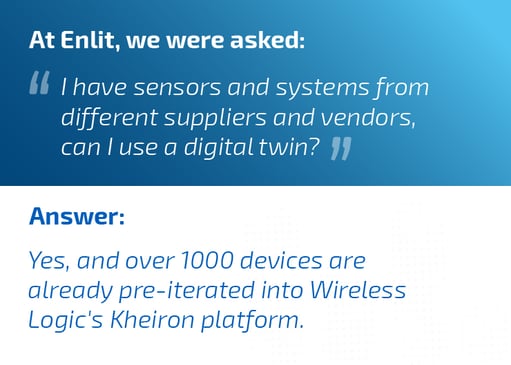
A digital twin is a clear, intuitive way to harness IoT data and make it meaningful, giving operators real-time visibility and monitoring, and remote asset management so operational or IT teams needn’t go out to devices. It unifies data from multiple sources and systems.
It can, for example, bring data from solar panels, battery storage and charge points together into one visual dashboard. A digital twin is the integration layer between legacy systems, IoT sensors and operational tools. It doesn’t require specialist coding skills to set up or use it, and it layers intelligence on top of infrastructure.
Interoperability
In many ways, IoT solutions converge IT and OT and discussions at Enlit pointed to an understanding of this interoperability.
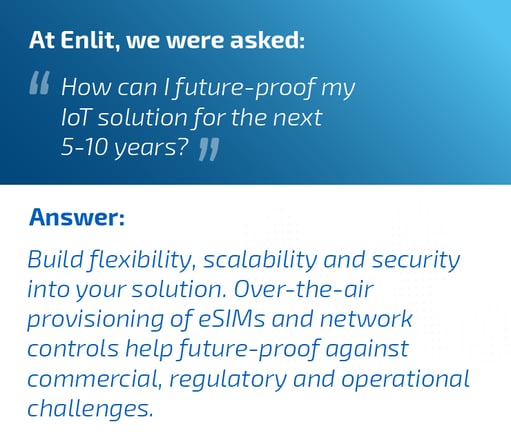
Enlit brings together enterprises, decision makers, IoT solutions providers and device manufacturers, enabling discussion and collaboration on challenges such as future-proofing, next-generation technologies and the regulatory and technical differences when deploying overseas.
Cybersecurity
Companies now have a greater understanding they must tackle cybersecurity at the start of an IoT project, but there is still fragmentation across the layers of an IoT solution.
Resilience must be built in from the start, and end-to-end, across complete solutions covering the device, network, software, processes and cloud. This is the only way for energy companies and suppliers to adopt the highest standards of safety, security and data protection.
IoT smart energy: how to optimise security and resilience
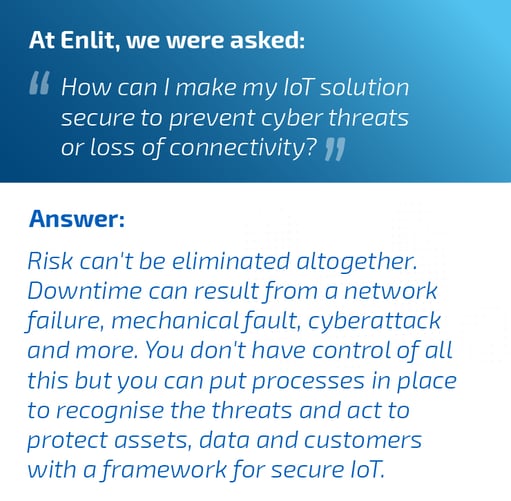
The IoT is helping to underpin the smart grid and energy ecosystem but is only an asset if it is secure and resilient. If infrastructure, equipment or systems suffer downtime, it could lead to significant energy outages.
Action comes in the form of proactive resilience measures, strategies to minimise downtime and tactics to recover rapidly and effectively from incidents. Energy companies and suppliers to the sector must:
- Adopt robust security measures with identity and access management, multi-factor authentication, encryption, vulnerability scanning, endpoint protection and network segmentation, anomaly and threat detection, and AI-driven analysis
- Design networks and systems with redundancy to prevent single points of failure; load balance and auto-scale to handle demand fluctuations and implement automated failover
- Plan capacity, use content delivery networks, caching, edge computing and rate-limit to prevent overloading
- Monitor infrastructure, applications and devices
- Do predictive maintenance, supported by AI-driven analytics, and implement self-healing systems
- Update software and maintain formal change control procedures to reduce risk during updates. Implement version control of configurations and audit systems for compliance
- Have a disaster recovery plan and test it regularly.

How Wireless Logic can help
Talk to us about your IoT smart energy solution. Find out more about designing for and managing secure and resilient IoT.
Check out other blogs

The invisible attack: why edge devices are a hackers' favourite target
The best parasites don't kill their hosts. They move in quietly, make themselves comfortable, and carry on entirely undetected, helping themselves to...

IoT security used to be someone else's problem. The Cyber Resilience Act just changed that.
In September 2020, an employee at a UK water utility company called South Staffordshire PLC, opened a phishing email. It was, by all accounts, a...