eSIMs are set to take off for the IoT thanks to the latest GSMA standard SGP.32. eSIMs have a lot to offer - time and cost savings, streamlined logistics, simpler global deployments where permanent roaming is an issue -but each IoT project is different, and each enterprise has its own questions to be answered. To get you the information you need and determine if SGP.32 is the right solution for your business, Wireless Logic teamed up with Beecham Research to bring you the SGP.32 buyer’s guide. Read on for a taste of its insights.
Top 3 takeaways on the eSIM shift
- The SGP.32 GSMA standard has made eSIM an attractive option for the IoT
-
Reasons to use eSIM include flexibility, time and cost savings, simpler logistics and compliance with permanent roaming abroad
-
To use eSIM, first consider if you have the infrastructure and expertise to design, develop and implement successfully. If IoT isn't your main business, you would benefit from engaging a trusted IoT solutions provider.
Benefits of eSIM for IoT
Standard SIM cards are removable; they are designed to be changed and swapped out if required, for example to switch to another mobile network.
eSIMs, on the other hand, come with the ability to hold multiple entire profiles and physical security benefits, but the main advantage they provide is flexibility as eSIM’s software infrastructure enables it to store and deploy SIM profiles that can be reprogrammed over the air (OTA).
That way, instead of sending an engineer to change a SIM so an IoT device can connect to a different network, enterprises or operators can do this remotely. That is especially convenient for the IoT because devices are often located in remote or difficult-to-access areas. It can be hugely costly to send someone to attend them, particularly if there are many, potentially thousands, of devices to update.
This doesn’t mean there aren’t challenges managing eSIM profiles, though. Until recently, eSIM standards (SGP.02 and SGP.22) didn’t favour the IoT. Then the latest GSMA eSIM standard, SGP.32, was introduced. It is so significant to the IoT that it is expected to stimulate an uplift in the market to an estimated 195 million SGP.32 profile downloads in 2029 - 70% of all IoT[i].
Find out all you need to know about eSIM and the new standard in the SGP.32 buyer’s guide 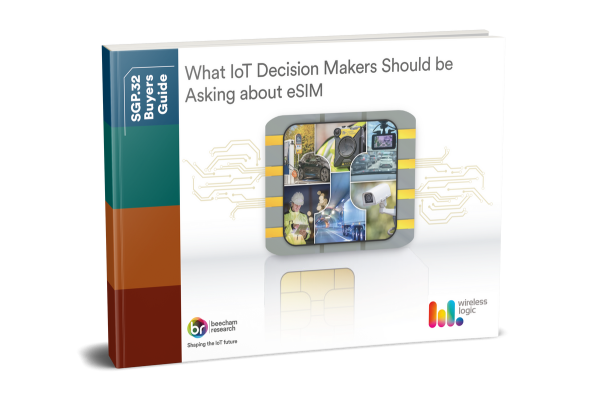
4 big reasons why the time is right for eSIM IoT
1. SGP.32 for enterprises
SGP.32 is designed specifically for the IoT. It enables a remote user to instruct the eSIM to pull a network profile from a secure server. That user can instruct many eSIMs to get the new profile simultaneously, which can be a huge time and cost saving for large IoT deployments.
This makes now the right time for eSIM for the IoT. SGP.32 reduces technical and commercial risk and lowers total cost of ownership (TCO). It does this in a range of ways, not least through remote SIM provisioning (RSP), single SKU enablement and connectivity management, which we will look at in turn.
2. Remote SIM provisioning
RSP describes the process and technology for reprogramming a SIM OTA. To do it, the operator - be that the enterprise deploying the IoT, device manufacturer, MNO or MVNO - must have carrier agreements in place to access and provision the relevant local eSIM profile/s from different MNOs.
RSP reduces the need for device visits, but it also helps IoT owners manage restrictions on permanent roaming by accessing local eSIM profiles. This is significant for deployments overseas.
3. Single SKU
With an eSIM, the same stock keeping unit (SKU) can apply to all an enterprise’s IoT devices or products, regardless of where they are going.
With a standard SIM, each product batch has a different SIM according to the network it is programmed to connect to. An eSIM goes into all products, regardless of where they are going, and is programmed to connect to the relevant local network when they get there.
This is a huge logistical and operational saving, in both time and cost.
4. Connectivity management
SGP.32 stands to change how organisations approach IoT connectivity management. It effectively decouples connectivity from hardware and operator constraints. The single SKU, and its impact, demonstrates this.
With a standard SIM, connectivity isn’t particularly flexible. With SGP.32 eSIM, it becomes a controllable service layer with those who manage deployments having the power to switch network more efficiently.
Having said that, eSIM isn’t totally plug-and-go, even with SGP.32. It requires integration with device manufacturing, remote provisioning infrastructure, carrier agreements with relevant MNOs and ongoing lifecycle management.
For enterprises to do this themselves, they would need the right systems, expertise and infrastructure. Instead, they can partner with an IoT solutions provider who has the skills and infrastructure and who can, in addition, supply a management platform.

Is eSIM right for your IoT?
eSIM is a sensible option when an IoT solution needs global reach, easier device logistics and/or remote profile switching. It has benefits for large-scale deployments and those that are difficult to reach including remote video surveillance, asset tracking, sensors and meters.
To help you decide if SGP.32 eSIM is the right technology for your IoT, ask yourself:
-
Will I need to change connectivity providers during the lifetime of the devices, for example to improve quality, comply with local rules or reduce costs?
-
Am I deploying in multiple countries or regions where roaming restrictions/data sovereignty laws differ?
-
Would operations benefit from a single global SKU?
-
Is my fleet of devices difficult or costly to access physically?
For a full decision checklist, get the SGP.32 buyer’s guide.

How to get started with eSIM IoT
The most important first stage of an IoT project is to consider if you have the infrastructure and expertise to design, develop and implement successfully. If IoT isn’t your main business, you would benefit from engaging a trusted IoT solutions provider.
They can help with the many considerations, that include the device, application and connectivity, but also security and resilience that must be factored in upfront and throughout.
The SGP.32 buyer’s guide has a comprehensive checklist of questions for providers, to help you produce your request for information (RFI). They include:
-
Do you support SGP.32 eSIM provisioning in production, and which GSMA-certified components do you operate?
- Do you provide rules-based automation of eSIM profile deployment transactions?
- How many carriers and eSIM profiles do you make available through your platform, and how do you manage access to these across different regions?
- How do you ensure local laws around data handling and roaming are adhered to over time?
- What capabilities do you have which assist with cybersecurity certifications (for go-to-market) and regulations (post-deployment monitoring)?
- What measures do you take to monitor and detect cybersecurity threats and breaches?
- How do you ensure only authorised devices can connect to your network and my cloud services?
- Do you offer a device management solution?
For the full RFI checklist, get the SGP.32 buyer’s guide.
How Wireless Logic can help
Wireless Logic’s eSIM for IoT enables remote network switching and supports 4G, LTE-M, NB-IoT and 5G alongside the widest range of eSIM profiles in IoT, delivering flexibility, resilience and compliance from factory to field.
Get more information:
-
Enterprise eSIM connectivity for global IoT
-
SGP.32 buyer’s guide: what IoT decision makers should be asking about eSIM
-
How to assess and reduce TCO in IoT.
[i] ABI Research – see https://wirelesslogic.com/blog/why-its-time-to-look-again-at-esim-for-the-iot
Check out other blogs

How does eSIM enable resilient and cost effective IoT?
If you haven’t considered eSIM for your IoT solution, or dismissed it in the past, look again. The latest standard (SGP.32) makes eSIM better suited...

What is AIoT?
PCI-DSS v4.0.1, payment fraud and the new IoT attack surface
Digital payments are scaling rapidly across point-of-sale (POS) terminals, EV charge points, kiosks, unattended retail and smart ticketing systems....