Anomaly & Threat Detection is designed to support organisations in meeting a range of cybersecurity, product security and resilience requirements, depending on their sector, geography and use case. These may include regulations such as NIS2, the EU Cyber Resilience Act (CRA), the UK Product Security and Telecommunications Infrastructure (PSTI) Act and associated regulations, and UN Regulation No. 155 for connected vehicles.
Where relevant, Anomaly & Threat Detection may also contribute to broader compliance and assurance activities under frameworks such as DORA, PCI DSS, and applicable data protection and privacy laws, including GDPR.
Anomaly & Threat Detection provides continuous IoT network monitoring, threat detection logs and audit-ready reporting to support security and compliance teams in evidencing due diligence. However, Anomaly & Threat Detection is only one component of a wider compliance programme, and organisations remain responsible for ensuring full compliance with all applicable legal and regulatory requirements.
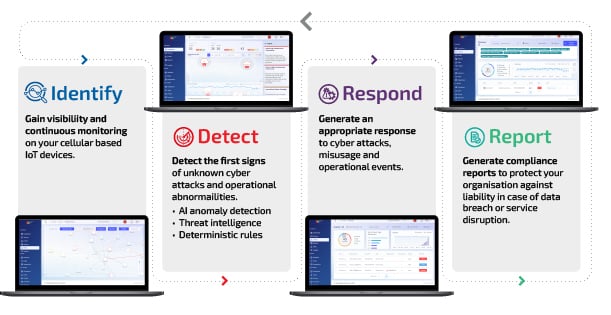
IoT devices are attractive targets because they are often under-monitored and difficult to patch. Common threats include unauthorised access, device impersonation, data exfiltration, lateral network movement, firmware exploits, and denial-of-service attacks. Devices operating outside the corporate IT perimeter are especially exposed. Anomaly & Threat Detection uses AI-driven anomaly detection to identify abnormal behaviour in real time, reducing mean time to detection from weeks to minutes.
Traditional IT security tools are built for managed networks and don't work for devices deployed in the field — remote sensors, EV chargers, payment terminals, or fleet trackers operating over cellular networks. Anomaly & Threat Detection is an agentless IoT cybersecurity solution that monitors traffic and behaviour at the network level, with no software installation or firmware changes required. If a device is on your connectivity platform, Anomaly & Threat Detection can see it.
Anomaly & Threat Detection establishes a behavioural baseline for every device on your network, learning what normal looks like in terms of data volumes, communication patterns, and protocol usage. When a device deviates from that baseline, Anomaly & Threat Detection flags it and generates an alert. Because this approach identifies novel behaviour rather than known attack signatures, it can detect zero-day threats that traditional tools would miss.
No. Anomaly & Threat Detection is fully agentless — nothing is installed on your devices and no firmware changes are required. Monitoring happens at the network level through your existing Wireless Logic connectivity. Deployment is typically completed within days with no operational disruption to your device estate.
General-purpose network monitoring tools are designed for IT infrastructure and lack the protocol knowledge needed to monitor IoT environments effectively. Anomaly & Threat Detection is built specifically for connected device estates, applying threat intelligence tuned to the attack vectors IoT devices actually face. The result is faster detection, fewer false positives, and IoT security that works without a separate platform.